FAQ
This section contains all the frequently asked questions about water heater and anode rod.

Warranty
Yes. Every Corro-Protec powered anode rod comes with a 20-year limited warranty covering the product itself. While the system helps protect your water heater from internal corrosion and can extend its lifespan.
To activate your free 20-year warranty, simply click below and complete the quick product registration. If you ever need assistance, our support team is ready to help and the claim process is simple.
No. Under the Magnuson-Moss Warranty Act, a manufacturer cannot void your warranty just because you used an aftermarket part. If the Corro-Protec powered anode rod is properly installed and compatible, its presence alone should not invalidate warranty coverage. A claim can only be denied if the manufacturer proves the anode directly caused the damage or if there was consumer misuse.
No. Replacing a sacrificial anode with a compatible, properly installed powered anode is standard maintenance and, by itself, should not void your manufacturer’s warranty. In Canada, denying warranty coverage because of a third-party part generally requires the manufacturer to show that the part caused the failure, not simply that it was installed. This is governed by applicable provincial consumer protection laws.
Choose a brand with accessible support, clear installation instructions, and proper documentation. Look for materials designed for long-term use inside a water heater and suitable for different water conditions.
A proven track record also matters. Be careful with copycat products and short-lived marketplace brands that may offer little technical support, unclear certifications, or warranties that could be difficult to claim.
Corro-Protec has been in the powered anode business since 2006, is backed by thousands of customer reviews, and is WQA Gold Seal certified. That proven track record, accessible support, and recognized certification make it a safer long-term choice when warranty compliance matters.
Yes. Replacing a sacrificial anode with a compatible, properly installed Corro-Protec Powered Anode Rod is standard anode maintenance, not a prohibited modification. Manufacturers typically require regular anode inspection and replacement when the sacrificial anode is depleted to maintain the manufacturer’s warranty.
Warranty protection also depends on applicable law. In the U.S., the Magnuson-Moss Warranty Act generally prevents a manufacturer from denying coverage solely because an aftermarket part was used. In Canada, provincial consumer protection laws apply. In both cases, a third-party part generally becomes a warranty issue when it causes or contributes to the failure, not simply because it was installed.
No, the Corro-Protec powered anode rod does not void your A. O. Smith water heater warranty. In fact, manufacturers consider powered anode rods maintenance parts that support the proper functioning and longevity of the tank. Anode inspection and maintenance every 1–2 years are typically required to maintain the manufacturer’s warranty.
Replacing a sacrificial anode with a powered anode is standard anode maintenance, not a prohibited modification. Therefore, installing a compatible, properly installed powered anode rod should not void your water heater warranty.
In the United States, warranty protection is governed by the Magnuson-Moss Warranty Act and, in Canada, by various provincial consumer protection laws.
To understand how warranty protection works in the U.S. and Canada, what can actually void a water heater warranty, which certifications matter, and how to choose and install a powered anode rod without creating unnecessary warranty risks, read our complete guide to water heater warranties.
No, the Corro-Protec powered anode rod does not void your Whirlpool water heater warranty. In fact, manufacturers consider powered anode rods maintenance parts that support the proper functioning and longevity of the tank. Anode inspection and maintenance every 1–2 years are typically required to maintain the manufacturer’s warranty.
Replacing a sacrificial anode with a powered anode is standard anode maintenance, not a prohibited modification. Therefore, installing a compatible, properly installed powered anode rod should not void your water heater warranty.
In the United States, warranty protection is governed by the Magnuson-Moss Warranty Act and, in Canada, by various provincial consumer protection laws.
To understand how warranty protection works in the U.S. and Canada, what can actually void a water heater warranty, which certifications matter, and how to choose and install a powered anode rod without creating unnecessary warranty risks, read our complete guide to water heater warranties.
No, the Corro-Protec powered anode rod does not void your Bradford White water heater warranty. In fact, manufacturers consider powered anode rods maintenance parts that support the proper functioning and longevity of the tank. Anode inspection and maintenance every 1–2 years are typically required to maintain the manufacturer’s warranty.
Replacing a sacrificial anode with a powered anode is standard anode maintenance, not a prohibited modification. Therefore, installing a compatible, properly installed powered anode rod should not void your water heater warranty.
In the United States, warranty protection is governed by the Magnuson-Moss Warranty Act and, in Canada, by various provincial consumer protection laws.
To understand how warranty protection works in the U.S. and Canada, what can actually void a water heater warranty, which certifications matter, and how to choose and install a powered anode rod without creating unnecessary warranty risks, read our complete guide to water heater warranties.
No, the Corro-Protec powered anode rod does not void your State water heater warranty. In fact, manufacturers consider powered anode rods maintenance parts that support the proper functioning and longevity of the tank. Anode inspection and maintenance every 1–2 years are typically required to maintain the manufacturer’s warranty.
Replacing a sacrificial anode with a powered anode is standard anode maintenance, not a prohibited modification. Therefore, installing a compatible, properly installed powered anode rod should not void your water heater warranty.
In the United States, warranty protection is governed by the Magnuson-Moss Warranty Act and, in Canada, by various provincial consumer protection laws.
To understand how warranty protection works in the U.S. and Canada, what can actually void a water heater warranty, which certifications matter, and how to choose and install a powered anode rod without creating unnecessary warranty risks, read our complete guide to water heater warranties.
No, the Corro-Protec powered anode rod does not void your Rheem water heater warranty. In fact, manufacturers consider powered anode rods maintenance parts that support the proper functioning and longevity of the tank. Anode inspection and maintenance every 1–2 years are typically required to maintain the manufacturer’s warranty.
Replacing a sacrificial anode with a powered anode is standard anode maintenance, not a prohibited modification. Therefore, installing a compatible, properly installed powered anode rod should not void your water heater warranty.
In the United States, warranty protection is governed by the Magnuson-Moss Warranty Act and, in Canada, by various provincial consumer protection laws.
To understand how warranty protection works in the U.S. and Canada, what can actually void a water heater warranty, which certifications matter, and how to choose and install a powered anode rod without creating unnecessary warranty risks, read our complete guide to water heater warranties.
No, the Corro-Protec powered anode rod does not void your Reliance water heater warranty. In fact, manufacturers consider powered anode rods maintenance parts that support the proper functioning and longevity of the tank. Anode inspection and maintenance every 1–2 years are typically required to maintain the manufacturer’s warranty.
Replacing a sacrificial anode with a powered anode is standard anode maintenance, not a prohibited modification. Therefore, installing a compatible, properly installed powered anode rod should not void your water heater warranty.
In the United States, warranty protection is governed by the Magnuson-Moss Warranty Act and, in Canada, by various provincial consumer protection laws.
To understand how warranty protection works in the U.S. and Canada, what can actually void a water heater warranty, which certifications matter, and how to choose and install a powered anode rod without creating unnecessary warranty risks, read our complete guide to water heater warranties.
No, the Corro-Protec powered anode rod does not void your Richmond water heater warranty. In fact, manufacturers consider powered anode rods maintenance parts that support the proper functioning and longevity of the tank. Anode inspection and maintenance every 1–2 years are typically required to maintain the manufacturer’s warranty.
Replacing a sacrificial anode with a powered anode is standard anode maintenance, not a prohibited modification. Therefore, installing a compatible, properly installed powered anode rod should not void your water heater warranty.
In the United States, warranty protection is governed by the Magnuson-Moss Warranty Act and, in Canada, by various provincial consumer protection laws.
To understand how warranty protection works in the U.S. and Canada, what can actually void a water heater warranty, which certifications matter, and how to choose and install a powered anode rod without creating unnecessary warranty risks, read our complete guide to water heater warranties.
No, the Corro-Protec powered anode rod does not void your Ruud water heater warranty. In fact, manufacturers consider powered anode rods maintenance parts that support the proper functioning and longevity of the tank. Anode inspection and maintenance every 1–2 years are typically required to maintain the manufacturer’s warranty.
Replacing a sacrificial anode with a powered anode is standard anode maintenance, not a prohibited modification. Therefore, installing a compatible, properly installed powered anode rod should not void your water heater warranty.
In the United States, warranty protection is governed by the Magnuson-Moss Warranty Act and, in Canada, by various provincial consumer protection laws.
To understand how warranty protection works in the U.S. and Canada, what can actually void a water heater warranty, which certifications matter, and how to choose and install a powered anode rod without creating unnecessary warranty risks, read our complete guide to water heater warranties.
No, the Corro-Protec powered anode rod does not void your Kenmore water heater warranty. In fact, manufacturers consider powered anode rods maintenance parts that support the proper functioning and longevity of the tank. Anode inspection and maintenance every 1–2 years are typically required to maintain the manufacturer’s warranty.
Replacing a sacrificial anode with a powered anode is standard anode maintenance, not a prohibited modification. Therefore, installing a compatible, properly installed powered anode rod should not void your water heater warranty.
In the United States, warranty protection is governed by the Magnuson-Moss Warranty Act and, in Canada, by various provincial consumer protection laws.
To understand how warranty protection works in the U.S. and Canada, what can actually void a water heater warranty, which certifications matter, and how to choose and install a powered anode rod without creating unnecessary warranty risks, read our complete guide to water heater warranties.
No, the Corro-Protec powered anode rod does not void your GE water heater warranty. In fact, manufacturers consider powered anode rods maintenance parts that support the proper functioning and longevity of the tank. Anode inspection and maintenance every 1–2 years are typically required to maintain the manufacturer’s warranty.
Replacing a sacrificial anode with a powered anode is standard anode maintenance, not a prohibited modification. Therefore, installing a compatible, properly installed powered anode rod should not void your water heater warranty.
In the United States, warranty protection is governed by the Magnuson-Moss Warranty Act and, in Canada, by various provincial consumer protection laws.
To understand how warranty protection works in the U.S. and Canada, what can actually void a water heater warranty, which certifications matter, and how to choose and install a powered anode rod without creating unnecessary warranty risks, read our complete guide to water heater warranties.
No, the Corro-Protec powered anode rod does not void your Giant water heater warranty. In fact, manufacturers consider powered anode rods maintenance parts that support the proper functioning and longevity of the tank. Anode inspection and maintenance every 1–2 years are typically required to maintain the manufacturer’s warranty.
Replacing a sacrificial anode with a powered anode is standard anode maintenance, not a prohibited modification. Therefore, installing a compatible, properly installed powered anode rod should not void your water heater warranty.
In the United States, warranty protection is governed by the Magnuson-Moss Warranty Act and, in Canada, by various provincial consumer protection laws.
To understand how warranty protection works in the U.S. and Canada, what can actually void a water heater warranty, which certifications matter, and how to choose and install a powered anode rod without creating unnecessary warranty risks, read our complete guide to water heater warranties.
No, the Corro-Protec powered anode rod does not void your Buderus water heater warranty. In fact, manufacturers consider powered anode rods maintenance parts that support the proper functioning and longevity of the tank. Anode inspection and maintenance every 1–2 years are typically required to maintain the manufacturer’s warranty.
Replacing a sacrificial anode with a powered anode is standard anode maintenance, not a prohibited modification. Therefore, installing a compatible, properly installed powered anode rod should not void your water heater warranty.
In the United States, warranty protection is governed by the Magnuson-Moss Warranty Act and, in Canada, by various provincial consumer protection laws.
To understand how warranty protection works in the U.S. and Canada, what can actually void a water heater warranty, which certifications matter, and how to choose and install a powered anode rod without creating unnecessary warranty risks, read our complete guide to water heater warranties.
No, the Corro-Protec powered anode rod does not void your Suburban water heater warranty. In fact, manufacturers consider powered anode rods maintenance parts that support the proper functioning and longevity of the tank. Anode inspection and maintenance every 1–2 years are typically required to maintain the manufacturer’s warranty.
Replacing a sacrificial anode with a powered anode is standard anode maintenance, not a prohibited modification. Therefore, installing a compatible, properly installed powered anode rod should not void your water heater warranty.
In the United States, warranty protection is governed by the Magnuson-Moss Warranty Act and, in Canada, by various provincial consumer protection laws.
To understand how warranty protection works in the U.S. and Canada, what can actually void a water heater warranty, which certifications matter, and how to choose and install a powered anode rod without creating unnecessary warranty risks, read our complete guide to water heater warranties.
Install the powered anode according to the product instructions, confirm compatibility with your water heater, and follow local plumbing and electrical codes. If you are not comfortable with the installation, using a licensed plumber can help avoid warranty issues related to improper installation.
Also choose a product with recognized safety certifications. A compatible, properly installed Corro-Protec Powered Anode Rod should not, by itself, void your manufacturer’s warranty.
Use a compatible powered anode, follow the manufacturer’s installation instructions and local codes, and keep receipts and installation records. Clear documentation and proper installation make any warranty discussion more straightforward and help support your claim if issues arise. For more details, see our complete guide to powered anodes and water heater warranties.
The Magnuson–Moss Warranty Act is a U.S. federal law passed in 1975 that regulates written consumer product warranties. It requires clear warranty terms, restricts unfair warranty denials, allows consumers to use aftermarket parts and independent service providers, and provides legal recourse if a warranty is not honored. The FTC has affirmed that companies cannot deny warranty coverage solely because a third-party part or service was used when it is unrelated to the problem.
Manufacturers typically require anode inspection every 1–2 years and replacement when the sacrificial anode is depleted. How quickly an anode depletes can vary based on water chemistry, anode material, water usage, and other conditions.
Because anode replacement is part of required water heater maintenance, replacing a depleted sacrificial anode with a compatible powered anode is standard anode maintenance, not a prohibited modification.
Ask the manufacturer to identify the specific warranty term they believe applies and explain how the aftermarket anode caused or contributed to the failure. Keep your installation records, receipts, product documentation, and photos.
In the U.S., the Magnuson-Moss Warranty Act generally prevents a manufacturer from denying coverage solely because an aftermarket part was used. In Canada, applicable provincial consumer protection laws also apply.
A compatible, properly installed Corro-Protec Powered Anode Rod should not, by itself, void the manufacturer’s warranty.
A water heater warranty may be affected by improper installation, misuse, lack of required maintenance, unauthorized modifications, or damage caused by an incompatible part. Installing a compatible Corro-Protec Powered Anode Rod properly should not, by itself, void your manufacturer’s warranty.
In the U.S., warranty protection is governed by the Magnuson-Moss Warranty Act. In Canada, warranty rights are also protected by applicable consumer protection laws. A third-party part generally becomes a warranty issue when it causes or contributes to the failure, not simply because it was installed.
About Powered Anode Rod
The answer is YES. Since the sacrificial anode must sacrifice itself to protect the hot water tank, it is important that the anode is large enough to last for several years. However, the powered anodes rod do not work in the same way, so they are much smaller.
A powered anode related to electricity being fed into the anode to impose a flow of current rather than relying on natural electrolysis. The length and size of the anode, as well as the current sent by the rectifier will influence the life expectancy of the anode. Corro-Protec anodes have been designed to work for more than 40 years, no matter how hard your water is. In order to know more about the lifetime of the current anodes, I invite you to visit our blog post: Tests of Powered Anode
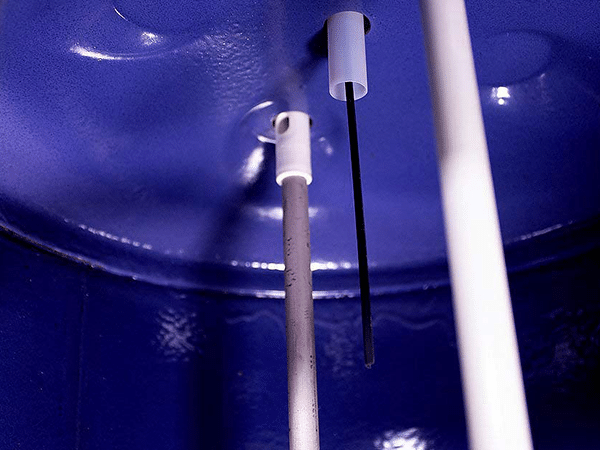
A powered anode rod helps keep the inside of your water heater clean and free of limescale, which improves heat transfer and reduces energy consumption over time. By preventing corrosion and mineral buildup, your heating element doesn’t have to work as hard, helping your water heater maintain peak efficiency for many years. This means lower energy costs and a longer tank lifespan.
By preventing scale formation, a Corro-Protec powered anode rod can improve efficiency by up to 9.75%, based on long-term internal testing.
In most cases, the rotten egg smell disappears within 24 hours of installing a Corro-Protec powered anode rod. The system uses a low, safe electric current that instantly stops the reaction between sulfur bacteria and the sacrificial anode, which is what creates the smell. If the odor is strong or has built up over time, it can take up to a couple of days for the smell to fully clear.
Unlike traditional sacrificial anode rods, a powered anode rod uses electricity to create a small current that prevents corrosion without being consumed.
Yes, powered anodes does work. They are a proven and effective technology used to protect the metal in your water heater from corrosion and rotten egg smell in hot water.
They work by producing a small electric current that counteracts the electrochemical reaction that would cause your water heater to rust.
Powered anode rods have been used in the water heater industry for many years due to their effectiveness in combating corrosion. Here are some reasons and historical context illustrating why they work well:
- Scientific Basis: The functionality of powered anodes is based on the well-understood principles of electrochemistry. By creating a small current, these anodes prevent the corrosive reaction that would normally occur in the water heater.
- Industry Adoption: Impressed-current anodes (another name for powered anodes) were first patented in the early 1960s and have been used in various industrial applications since, including water heaters, underground tanks, and marine structures. Their long history of use is a testament to their effectiveness.
- Adaptable to Water Conditions: Unlike sacrificial anodes, powered anodes can adjust to different water conditions, making them effective in a variety of environments.
- Longevity: The use of powered anodes can significantly extend the lifespan of water heaters, which has been observed and documented over the years.
- Solves the “Rotten Egg” Smell: Powered anodes can also prevent the sulfur smell often associated with sacrificial anodes, proving their effectiveness in improving the overall water quality.
Given this history and their continued use in various industries, powered anode rods have a proven track record of effectiveness.
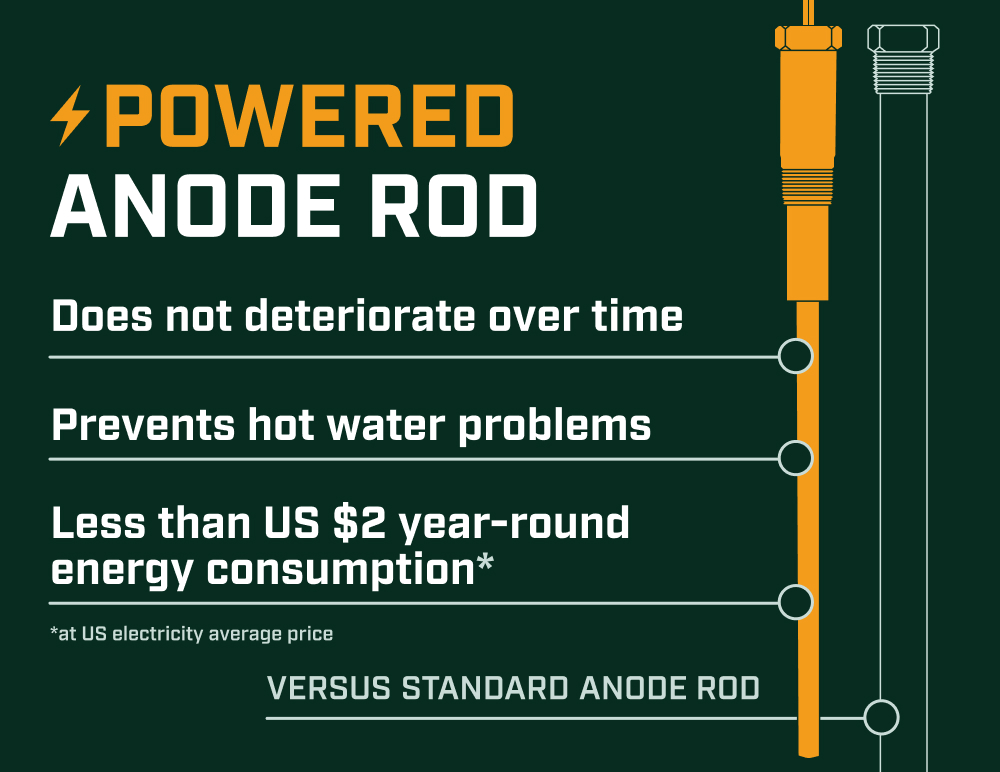
Why Corro-Protec is Unrivalled?
One of the top brands in the industry is Corro-Protec. They specialize in producing high-quality powered anodes that are designed to work with all types of water heaters and conditions. The Corro-Protec anodes are known for their reliability, durability, and superior performance.
While it’s true that Corro-Protec anodes are more expensive initially compared to traditional sacrificial anodes, they can offer substantial savings in the long run. Here’s why:
- Longevity: A powered anode rod such as the ones made by Corro-Protec is designed to last significantly longer than a standard sacrificial anode. Whereas a sacrificial anode may need to be replaced every few years, a powered anode can potentially last for the life of the water heater.
- Preventive Protection: By preventing corrosion more effectively, a powered anode can prolong the lifespan of your water heater. This means you won’t need to replace the entire heater as frequently, saving you a significant amount over time.
- Maintenance Costs: Traditional anodes require regular checks and replacement, which involves labor costs if you’re hiring a professional or time and effort if you’re doing it yourself. With a powered anode, once it’s installed, it requires minimal maintenance.
- Odor Prevention: Corro-Protec anodes are designed to stop the sulfurous “rotten egg” smell that can sometimes occur with sacrificial anodes. This not only improves the quality of your water, but also means you won’t need to spend extra money trying to fix this issue.
So while the upfront cost of a Corro-Protec powered anode is higher, the investment can pay off in the form of lower maintenance costs, a longer-lasting water heater, and better water quality.
Powered anode rods are recognized for their longevity, effectively protecting your water heater from corrosion for many years. Unlike sacrificial anodes which deteriorate over time, powered anodes can potentially outlast the lifespan of your water heater.
This lifespan often extends over a decade, with some high-quality brands like Corro-Protec offering powered anode rod designed to last more than 20 years. However, the precise lifespan can vary based on factors like water quality and usage patterns. Regardless, the long-lasting nature of powered anode rods contributes to their appeal, as they require less frequent checks and replacements compared to traditional sacrificial anodes.
Yes. It reduces limescale and sediment buildup inside your tank, helping maintain energy efficiency and extending water heater life.
Yes, a powered anode rod can help reduce noise by preventing sediment buildup and corrosion, which are common causes of noisy operation.
No, the unit draws less power than a night-light, about $3 per year. The Corro-Protec powered anode rod can save up to $40 per year in the U.S. and $30 in Canada on electricity bills through water heating costs.
Powered anode rods offer superior corrosion protection, eliminate odor issues, and require less maintenance than traditional sacrificial anode rods.
A traditional magnesium anode rod protects your tank by sacrificing itself over time. Once it’s depleted, the tank loses that protection so it must be inspected regularly and replaced when needed. Most water heater manufacturers recommend inspecting sacrificial anodes every 1 to 3 years (and sooner in hard water or softened water conditions). In some aggressive water conditions, a magnesium rod can be consumed much faster.
A Corro-Protec powered anode rod protects the tank using a small electrical current and a non-sacrificial titanium rod, so it doesn’t deplete like magnesium. That’s why, in normal use, it can provide long-term protection for many years without routine rod replacement.
Size matters only for sacrificial anodes, since they deteriorate themself to protect the tank. The Corro-Protec powered anode uses a small current to prevent corrosion. Built from titanium, it never degrades and provides continuous, maintenance-free protection for the life of the water heater.
Yes, glass-lined tanks still need protection because the glass coating can develop cracks or imperfections over time, exposing the metal beneath to corrosion. A powered anode rod like Corro-Protec provides consistent, long-term protection against rust and other water heater problems, ensuring your tank’s longevity and water quality.
The Corro-Protec Powered Anode Rod is designed to fit all tanks on the market, making it a reliable solution for both glass-lined and other types of water heaters.
No. Powered anodes need electricity to work, so protection pauses during an outage. There are no powered anodes that operate without power. In theory, this would require a battery or backup system, which adds cost, maintenance, and can easily fail when needed most. It’s a solution to a problem that doesn’t really exist because short outages won’t affect your tank’s protection.
About Anode Rod
In most cases, water heater anode rods are universal. They are typically hex-head with 3/4″ NPT threads and fit into a dedicated anode port located on the top of the tank.
Exceptions include:
Bradford White: Most models place the anode in the hot water outlet.
Buderus: Some models use threads larger than the standard 3/4″ NPT and also position the anode in the hot water outlet.
Corro-Protec offers anodes designed to fit either a dedicated anode port or a hot water outlet, ensuring compatibility with virtually any water heater and installation type.
Yes! Corro-Protec Powered Titanium Anodes are recognized by some insurance companies :
Our Corro-Protec anodes are made from titanium and coated with MMO, which improves their performance.
The stability of MMO (mixed metal oxide) coated titanium anodes have been used for almost 30 years. MMO coated titanium anodes are used in various environments such as seawater brackish water fresh water carbon backfill and concrete.
We recommend using the Corro-Protec powered anode rod for your Ao Smith water heater.
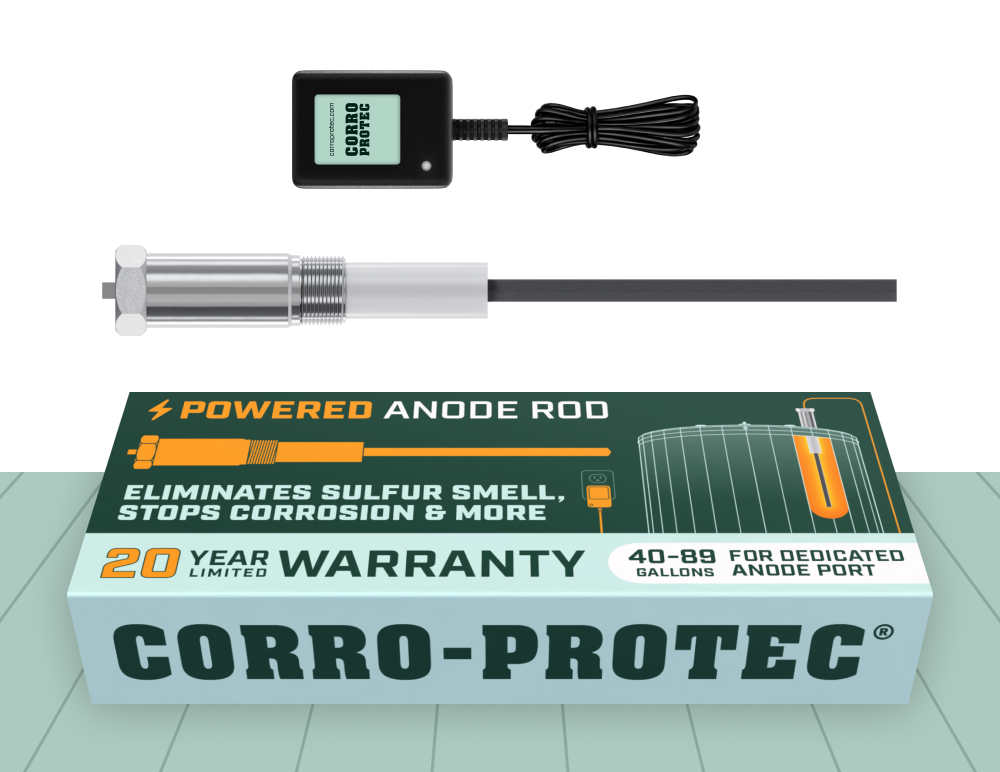
The Corro-Protec powered anode rod has several advantages that make it the best choice for your Ao Smith water heater:
- Effectiveness: The Corro-Protec powered anode rod has been proven to effectively stop corrosion in its tracks. It works by emitting a weak electrical current into the water, counteracting the electrochemical reaction that leads to rust and corrosion.
- Longevity: Unlike sacrificial anode rods that deteriorate over time and need to be replaced, the Corro-Protec powered anode rod does not degrade. This means it will last significantly longer, saving you time and money on replacements.
- Compatibility: The Corro-Protec powered anode rod is fully compatible with all models of Ao Smith water heaters. Whether you have a gas, electric, tankless, or hybrid water heater, the Corro-Protec anode rod will provide the necessary protection.
- Easy Installation: The Corro-Protec powered anode rod is designed for easy installation. You don’t need to be a professional plumber to install it. Simple instructions are provided, making the process straightforward.
- Environmentally Friendly: The Corro-Protec powered anode rod is more environmentally friendly compared to sacrificial anode rods. They do not degrade or dissolve into your water supply, making it a more eco-conscious choice.
By using a Corro-Protec powered anode rod, you are ensuring the longevity and optimal performance of your Ao Smith water heater.
Absolutely, we’ve designed a range of models to ensure optimal protection for water heaters of all sizes, enhancing their efficiency and longevity. Even if your water heater’s capacity is less than 90 gallons, a residential anode can be a valuable addition.
No, you need to select your real water heater size. All our Corro-Protec anodes have been designed to give optimal protection for different water heater size. Buying the bigger model will not make any difference.
Absolutely. You can use the Corro-Protec powered anode rod safely with any water treatment system, including all types of water softeners. No matter what softener you’re using, the Corro-Protec rod adjusts automatically to work effectively with your water.
It’s also worth noting that many water heater manufacturers mention in their maintenance guides that softened water can deplete a sacrificial (magnesium/aluminum) anode rod faster, which may require more frequent inspection and replacement to maintain performance and keep the warranty valid.
More information about Water Softener

How Does a Water Softener Work: A Detailed Explanation
Water softening is a process that can greatly improve the quality of your water and extend the life of your appliances, especially water heaters. However, […]

Water Softener Shower Head : 1 Better Alternative
Ongoing exposure to hard water can reduce your shower head flow rate by up to 75%. While many homeowners turn to a water softener shower head, […]
We’ve developed different models that can be installed in all water heater brands starting from 10 gallons to 120 gallons, including a specific model for Bradford White water heaters, where the anode is most often located in the hot water outlet. Corro-Protec fits on electric, gas, solar, hybrid, geothermal and indirect water heaters.
If you ordered an anode rod for the dedicated anode port, but you actually need to install your anode in the hot water outlet, visit corroprotec.com/contact-us to proceed with the exchange. If you chose the wrong tank capacity contact us at corroprotec.com/help to confirm compatibility. Important: Never install a dedicated-port model in a hot water outlet, or your warranty will be void.
If you ordered an anode rod for the hot water outlet (model for Bradford White), but you actually want to install your anode in the dedicated anode port, you can keep the model you have and follow this installation guide or visit corroprotec.com/contact-us to proceed with the exchange. If you chose the wrong tank capacity contact us as corroprotec.com/help to confirm compatibility.
Health & Safety
No. Since Titanium Powered Anodes are stable, there is no metallic leaching in the concerned environment and therefore no residual pollution.
Yes. Corro-Protec meets recognized North American standards for safety and water quality.
- Water Quality Certification: Tested and certified by the Water Quality Association against NSF/ANSI/CAN 372, confirming the product is lead-free and safe for potable water systems.
- Power Supply Safety Certification: Conforms to UL Std. 1310, certified to CSA Std. C22.2 No. 223, ETL Intertek 5003982, ensuring the power supply meets strict electrical safety standards.
The system is engineered to operate safely and efficiently, using less than $3 of electricity per year.
Yes, the use of electricity in water heaters by Corro-Protec’s system is safe. They use Impressed Current Cathodic Protection (ICCP) for their anode rods in water heaters. This method uses a low voltage DC power source to protect the water heater from corrosion.
One concern that some people might have is the introduction of electrical current into the water. However, the amount of current used by powered anode rods is very minimal and safe. This small current is precisely what prevents the corrosive reaction that causes rusting in the water tank.
Additionally, unlike sacrificial anodes that deteriorate over time due to the electrochemical process, powered anodes do not decompose. This means there is no breakdown of material that could potentially affect the water quality or the safety of the system.
Furthermore, companies like Corro-Protec prioritize the safety of their products. They ensure stringent quality control during manufacturing and carry out continuous testing to guarantee the products meet and exceed safety standards. Thus, you can confidently use a Corro-Protec powered anode rod in your water heater, knowing it is safe and effective in protecting your tank from corrosion.
Impressed Current Cathodic Protection (ICCP) is a widely used method for protecting a variety of metal structures submerged in water from corrosion. Here are a few examples:
- Sea Vessels: In the maritime industry, ICCP systems are installed on ships and submarines to prevent the corrosive effects of seawater. This system uses an external power source to generate a protective electric current that counteracts the corrosion process, ensuring the vessel’s hull remains intact.
- Piers and Harbors: ICCP systems are also used to protect piers, wharves, and offshore platforms from the constant threat of corrosion. These structures, being in direct contact with seawater, can quickly degrade without such protection. ICCP systems ensure the longevity of these important infrastructures.
- Underground and Underwater Pipelines: ICCP is widely used to protect pipelines carrying water or other substances. Given their often inaccessible locations, ICCP’s reliable and low-maintenance nature makes it an ideal choice for protecting these vital infrastructures.
Yes, the Corro-Protec will turn off by itself if there’s no water inside the tank. This will not affect the powered rod in any way.
Installation
Yes, it is possible to install Corro-Protec by yourself. With all tools needed, it will take you about 15 minutes to install it.
A complete step-by-step guide is included inside the box for an easy installation. Each guide are also available on this page: https://www.corroprotec.com/installation-guide/
Corro-Protec fits the vast majority of water heaters sold on the market. It works with nearly
all storage tank-style models, except tankless, stainless steel, or plastic-lined units, as these
do not use an anode. For all others, it provides reliable, long-term corrosion protection.
Yes. Our powered anode rod can be installed in a used water heater. While it cannot reverse existing corrosion, it will prevent future damage and extend the life of your tank. When you replace your water heater, you can simply move Corro-Protec to the new unit, protect your new tank from day one, and maintain your Corro-Protec warranty.
Some fiberglass hot water tanks require anodes to protect certain metal parts in the tank. If your tank is equipped with a magnesium anode, you can install a Corro-Protec.
In most cases, these tanks do not have anode and do not need any additional protection.
While the installation of a Corro-Protec Powered Anode Rod does not necessarily require a torque measurement, if you choose to use one, aim for about 22 foot-pounds. This range is a general guideline to ensure a secure fit without applying excessive force, which could potentially damage the water heater’s tank or threads.
The Corro-Protec powered anode rod is only 12 inches tall, so in most cases you’ll only need about a foot of vertical clearance to install it on your water heater. This makes it easy to fit in basements, closets, or tight utility spaces.
If you need to remove your old sacrificial anode rod, keep in mind it’s usually much longer and may require extra space. If clearance is limited, the rod can be cut into sections during removal without affecting your installation.
Once the old rod is out, installing the Corro-Protec is quick and easy, even in confined areas.
Since 2006, Corro-Protec has been trusted in hundreds of thousands of homes across North America. If your plumber is unfamiliar with powered anode rods, they can contact us for training at info@corroprotec.com or 1-877-466-6660. Installers can also join our reseller network at corroprotec.com/become-a-retailer to stay at the forefront of water heater technology. Corro-Protec is also a DIY-friendly product, and most homeowners install it themselves by following the instruction manual.
To install our powered anode rod into the hot water outlet (standard for Bradford White since most of their tanks do not have a dedicated anode port), you will need to exchange your model for our hot water outlet model. Visit corroprotec.com/help to make the exchange, or visit corroprotec.com/blog/water-heater-anode-rod-location for more information.
Some water heaters share the anode location with the hot water outlet. In that case, the anode must be installed in the same location. For a powered anode rod, you can use the Corro-Protec wye-piece fitting and the model designed for this type of installation.
To successfully remove your old anode and install your Corro-Protec, certain tools are required. A ratchet wrench fitted with a 1 1/16” (27 mm) socket will be necessary for the removal process. Meanwhile, a socket of 1 3/16” (31 mm) size or an adaptable wrench is recommended for the installation of the Corro-Protec. In addition, a square-headed screwdriver and universal pliers should also be at hand for the operation.
If you have an impact wrench, this could help you remove a stuck sacrificial anode rod.
¾” NPT (National Pipe Thread) is the standard thread size for the vast majority of residential water heater anode rods. This size is compatible with most major brands, including AO Smith, Bradford White, Rheem, State, Kenmore, GE, Whirlpool, Reliance, and many others. If you have a typical residential water heater, the chances are extremely high that it uses a ¾” NPT thread, as this is the industry standard across thousands of models.
Larger thread sizes are very uncommon and are typically found only on a small number of specific models or larger, more commercial-style tanks.
One notable exception is certain Buderus models, which use a 1” NPT thread. This is not typical for standard residential tanks. If you have a Buderus unit, you can find the correct model here:
https://www.corroprotec.com/accessories/for-buderus-water-heater/
Also, keep in mind that the socket (head) size used to remove or install the anode rod (for example, 1-3/16” vs 1-1/16”) does not affect the NPT thread size. The hex head size is only for installation tools; the thread size remains ¾” NPT in standard residential models.
Maintenance & Care
The Corro-Protec does not require any special maintenance. Leave it connected at all times, and it will work only if necessary. Even if you turn off the hot water tank, if there is still water in the tank, the Corro-Protec will remain functional to prevent corrosion. If you empty the tank, the Corro-Protec will turn off automatically because the water acts as a conductor between the anode and the ground.
An impressed current anode does not function as a heating element. There is no danger in emptying the water from the tank without disconnecting the anode.
Yes. Even if the powered anode pauses during a power outage, your water heater won’t be damaged. Corrosion is a slow process, so short interruptions have no real impact. Once power is restored, the anode resumes protection automatically. Only a months-long outage could affect the tank’s lifespan.
It is possible to find rust residues in your hot water after the installation of a Powered Anode Rod. The anode cleans the tank, so residues will be present in the water throughout the cleaning process.
Limescale may form if the anode is too close to the walls of the hot water tank and the current flows too quickly between the anode rod and the tank. Corro-Protec powered anode, unlike other anodes, has a design that prevents this type of reaction. Indeed, the white plastic present in the top of the titanium anode prevents this kind of reaction and ensures that the anode is well positioned in the tank.
To help prevent corrosion and keep performance consistent, flush the tank periodically (as recommended by the manufacturer), check the thermostat settings, and inspect the anode rod. Staying on top of these tasks annually can help your water heater run efficiently for years. Consider upgrading to a powered anode rod for long-term corrosion protection, and to help reduce sediment buildup in the tank and scale on electric heating elements.
Cold weather can freeze pipes and reduce hot water performance because the incoming water is colder, which can increase heat-up time and energy use.
This can happen if the water heater isn’t heating properly. Common causes include a tripped breaker, a failed heating element or thermostat, a pilot/ignition issue (gas units), sediment buildup, or frozen pipes in cold weather.
Flushing your water heater at least once a year will remove sediment and maintain optimal performance.
Power Supply & Rectifier
The voltage automatically adjusts based on the resistance of your water. If there’s a very low voltage, it suggests that your water is highly conductive. In such situations, the anode doesn’t require a large current to ensure adequate protection. The key factor to consider is the mA level within the water heater. Importantly, there’s no need to measure the voltage; if any issue arises, the Corro-Protec power supply’s green light will turn off. This light is designed to illuminate only when a specific current threshold is achieved, indicating that the protection mechanism is operational.
Yes, The Corro-Protec rectifier meets the following requirements:
- Conforms to UL STD. 1310
- Certified to CSA STD. C22.2 NO.223
If you want to learn more about the tests performed on our anodes, visit : https://www.corroprotec.com/blog/tests-of-powered-anode-iccp/
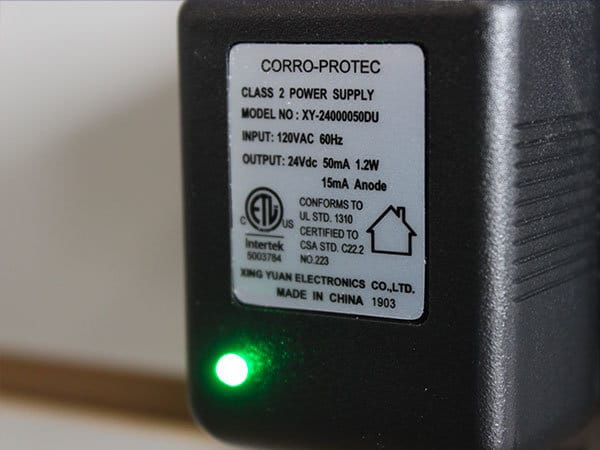
To ensure that the cathodic protection works, the following conditions must be met:
- The rectifier must be connected
- Corro-Protec must be connected to the rectifier
- The negative side must be installed on the water heater, as indicated in the instruction manual.
- The water heater must be functional (filled and operational)
If the above conditions are met and the indicator light is not lit, please contact us to complete a claim at: https://www.corroprotec.com/troubleshooting-and-warranty-claim/
Our powered anode rod can protect your water heater tank from corrosion and rust, extend the service life of your water tank, remove the rotten egg/sulfur smell in 24 hours, so that you can have clean, tasteless hot water. A green LED light on the power supply allows you to check if the system is running properly, making your life easier and more convenient
Our powered anode uses very little electricity. Internal testing confirms that its operating cost remains extremely low throughout the year. Since the amount of current can vary slightly depending on the water quality in your region, exact consumption may differ from one household to another. On average, our best-selling powered anode rod consumes about $2-$3 in electricity per year.
Overall, by reducing scale and sediment buildup, our powered anode rod saves up to 10% in water heating energy costs each year which is an average of US $40 in United States. In Canada, the estimated savings are $30 CAD due to lower energy cost. Estimated savings after one year of installation, based on internal testing and independent sources. Results may vary depending on the water heater unit, water quality, and usage patterns.
All our Corro-Protec models include a certified 12-foot power supply cord, ensuring safe operation, easy installation, and flexible placement.
Note that our Corro-Protec for RV (12 Volts version) includes a 3-foot cord.
Smelly Water & Odor Issues
The rotten egg smell in hot water is usually caused by hydrogen sulfide gas. This gas can form inside the water heater when sulfur-reducing bacteria interact with sulfates in the water, especially in the presence of a magnesium anode rod. The warm environment inside the tank creates ideal conditions for this reaction.
A rotten egg smell in water is typically caused by hydrogen sulfide gas. This can result from:
- – Bacterial activity in plumbing or water systems
- – Sulfur-rich well water
- – A reaction inside the water heater involving the magnesium anode rod
The anode rod is a metal rod installed in most water heaters to help prevent the tank from rusting.
The sulfur smell is primarily caused by hydrogen sulfide gas, often produced when sulfate-reducing bacteria (SRB) interact with sulfates in warm water heater conditions. A magnesium anode rod can also contribute to this reaction in certain water conditions.
First, check if the smell is in hot water, cold water, or both. If it’s only in hot water, the water heater is usually the source and upgrading to a powered anode rod is often the best long-term fix. If it’s in cold water or both, focus on treating the well or plumbing system with sanitizing or filtration based on your water test results.
You can remove the bad smell in your hot water by removing the reacting magnesium anode rod that comes in contact with the magnesium in the water. However, this deprives your water heater of its only protection against rust. You can choose an aluminum anode rod that requires more maintenance or the titanium Corro-Protec impressed current anode that eliminates unpleasant odours and offers 20 years of protection against rust.
Heavy rain can introduce additional organic material or sulfur compounds into groundwater. This can temporarily increase hydrogen sulfide levels, which may cause a stronger sulfur smell in well water.
To fix well water that smells like rotten eggs, consider the following solutions:
- If the smell is worse in hot water or only present in hot water, upgrade to a powered anode rod in the water heater
- Shock chlorination to disinfect the well and plumbing
- Installing an aeration and filtration system to remove hydrogen sulfide gas
- Using activated carbon filters to reduce sulfur odors
- Si el olor es más fuerte en el agua caliente o solo está presente en el agua caliente, actualizar a una varilla de ánodo eléctrica en el calentador de agua
Sulfur (hydrogen sulfide gas) in well water is generally not harmful at low concentrations, but it can affect taste and odor. Higher concentrations may cause pipe corrosion, staining, or other plumbing issues. Water testing is recommended to determine the proper treatment.
Flushing the water heater can provide temporary relief by reducing sediment and bacteria. In some cases, sanitizing the tank using a manufacturer-approved method, such as hydrogen peroxide, can also help temporarily. If the root cause is an anode reaction, upgrading to a powered anode rod is typically the more permanent solution.
Sacrificial anode rods should be inspected regularly and replaced when significantly depleted. Many water heater manufacturers recommend inspection every 1 to 3 years, and sooner in aggressive water conditions. If the anode is heavily worn or the steel core is exposed, it is time to replace it.
This usually indicates hydrogen sulfide gas caused by sulfur bacteria, trapped food particles in the drain, or contamination in the plumbing or water supply. Flushing the pipes with a chlorine solution or cleaning the drain can help if the issue is localized. If the odor persists, test the water to identify the source and treat it accordingly.
To treat smelly water, it is recommended to use the Corro-Protec powered anode rod. This type of anode rod eliminates the bacteria responsible for the rotten egg smell, sulfur smell, in less than 24 hours. In addition, the Corro-Protec doubles the life of your water heater, unlike a sacrificial anode that can also be the cause of the odor.
If your hot water smells like onions, it can be caused by different factors. Here is a list of the main factors:
- – A prolonged absence can dry out the pipes and lead to onion and sewer odour
- – A clogged drain
- – Incorrect temperature setting of the water heater that causes bacteria to grow
- – The metal in the water heater tank
If your hot water smells like oil, it is possible that the water supply or plumbing has been contaminated with gasoline, oil or bacteria. This can be a health risk. In rarer cases, you may notice an oil smell in a new water heater caused by a chemical reaction between the water and the tank components. This should disappear in a few weeks.
Understanding Anode Rods
An anode rod protects the metal lining of your hot water heater from corrosion by attracting corrosive elements in the water.
Anode rods are typically made of magnesium, aluminum, or a combination of aluminum and zinc, whereas powered anode rods are primarily made of titanium.
A magnesium anode rod is a water heater component made of magnesium. It helps prevent corrosion by attracting corrosive elements away from the tank and toward the rod instead. A magnesium anode rod is often more effective in soft water conditions.
For best results (and to keep your tank warranty valid), follow your water heater manufacturer’s maintenance guidelines. Many recommend inspecting the anode rod every 1 to 3 years and replacing it when needed.
An aluminum anode rod is made primarily of aluminum and is used in water heaters to help prevent corrosion by sacrificing itself to protect the tank. It’s often preferred in hard water conditions and is generally known for offering greater durability than magnesium anodes.
For best results (and to keep your tank warranty valid), follow your water heater manufacturer’s maintenance guidelines. Many recommend inspecting the sacrificial anode rod every 1 to 3 years and replacing it when needed.
The main difference is their composition and reactivity. Magnesium rods are more reactive, so they often provide stronger corrosion protection, but they also sacrifice themselves faster and may need replacement sooner. Aluminum rods are less reactive, so they may offer slightly less protection in some water conditions, but they’re generally more durable and deplete more slowly, which is why they’re often chosen in hard water areas.
It’s also helpful to compare both to a powered anode rod. Unlike magnesium or aluminum, a powered anode uses an electrical current and a non-sacrificial rod (typically titanium), so it doesn’t deplete like a traditional anode rod and can provide long-term corrosion protection without periodic rod replacement.
It is preferable to choose a Corro-Protec impressed current anode in order to double the life of your water heater and eliminate unpleasant odours. For the sacrificial anode, it is recommended to use a magnesium anode, as aluminium residues that may be found in the water are harmful to health.
It is very difficult to answer this question, because no one wants to take a clear position on the subject. However, several studies suggest that aluminum may be a contributing factor to Alzheimer’s disease.
Knowing that an aluminum anode dissolves over time, it is normal to conclude that aluminum particles will end up in your hot water. Even if you do not consume the hot water directly, you are in contact with it when you take a bath or a shower.
Very often, plumber offer to change magnesium anode for an aluminium anode in order to try to fix the rotten egg smell in the hot water. You should know that better solution exists such as Corro-Protec Powered anode rod.
Yes, the length of a sacrificial anode rod matters because it determines how much magnesium or aluminum is available to protect the tank. A longer rod means more material to corrode, which usually translates to a longer protection period.
However, Corro-Protec powered anode rods work differently. They use a titanium rod with an impressed electric current, so they don’t rely on the rod being consumed over time. That’s why our anodes are only 12 inches long, they provide continuous protection for the entire tank regardless of their length.
This makes installation much easier, especially in tight spaces like basements or closets, while offering long-term, maintenance-free corrosion protection.
The size of your anode depends on your anode type and the capacity of your water heater. In the case of a sacrificial anode, its rod is much larger than an impressed current anode, because the more material there is, the longer it offers a protection time.For the Corro- Protec impressed current anode, its protection is provided by an electrical current that is proportional to the capacity in gallons of your water heater and not to the size of its rod.
Yes. An anode rod is essential to protect your tank from corrosion and leaks and to extend its lifespan. A storage tank should never operate without a working anode rod.
Most North American storage tank water heaters are equipped with at least one anode rod, and in some cases, two.
Whether your water heater is electric, gas, hybrid heat pump, solar, or geothermal, if it’s a standard glass-lined steel storage tank, it contains an anode rod. The purpose of the anode is to protect the steel tank from rusting, regardless of the energy source.
However, tankless water heaters do not use anode rods because they do not store water in a tank. Some specialty non-metal tanks (such as certain plastic or fiberglass-lined models) may not use an anode rod, since the tank material is not prone to rust like steel. Likewise, some stainless steel (and certain plastic) tank models may not require an anode rod, as their tank material is designed to resist corrosion differently.
Look for a hex head or plastic cap on the top of the tank. If you can’t find one, it may be integrated into the hot water outlet or missing entirely. Check your hot water tank installation manual for specific directions for your model.
Most anode rods are sacrificial, which means their design will corrode. Because this material is supposed to decompose it will eventually wear off in a few years and require replacing. A tankless water heater is equipped with no anode, the most common water heater has one of those rods.
It will still work, but the tank will corrode and fail much faster than it should. That’s why replacing or upgrading the rod is essential, and most water heater manufacturers require an anode rod inspection every 1 to 3 years (depending on the manufacturer) as part of routine maintenance and replacement to keep the warranty valid.
When an anode rod goes bad, the water heater tank becomes vulnerable to rust and corrosion, potentially leading to leaks and reduced efficiency.
A bad anode rod typically appears heavily corroded, with visible pitting, deep grooves, or large areas of missing material.
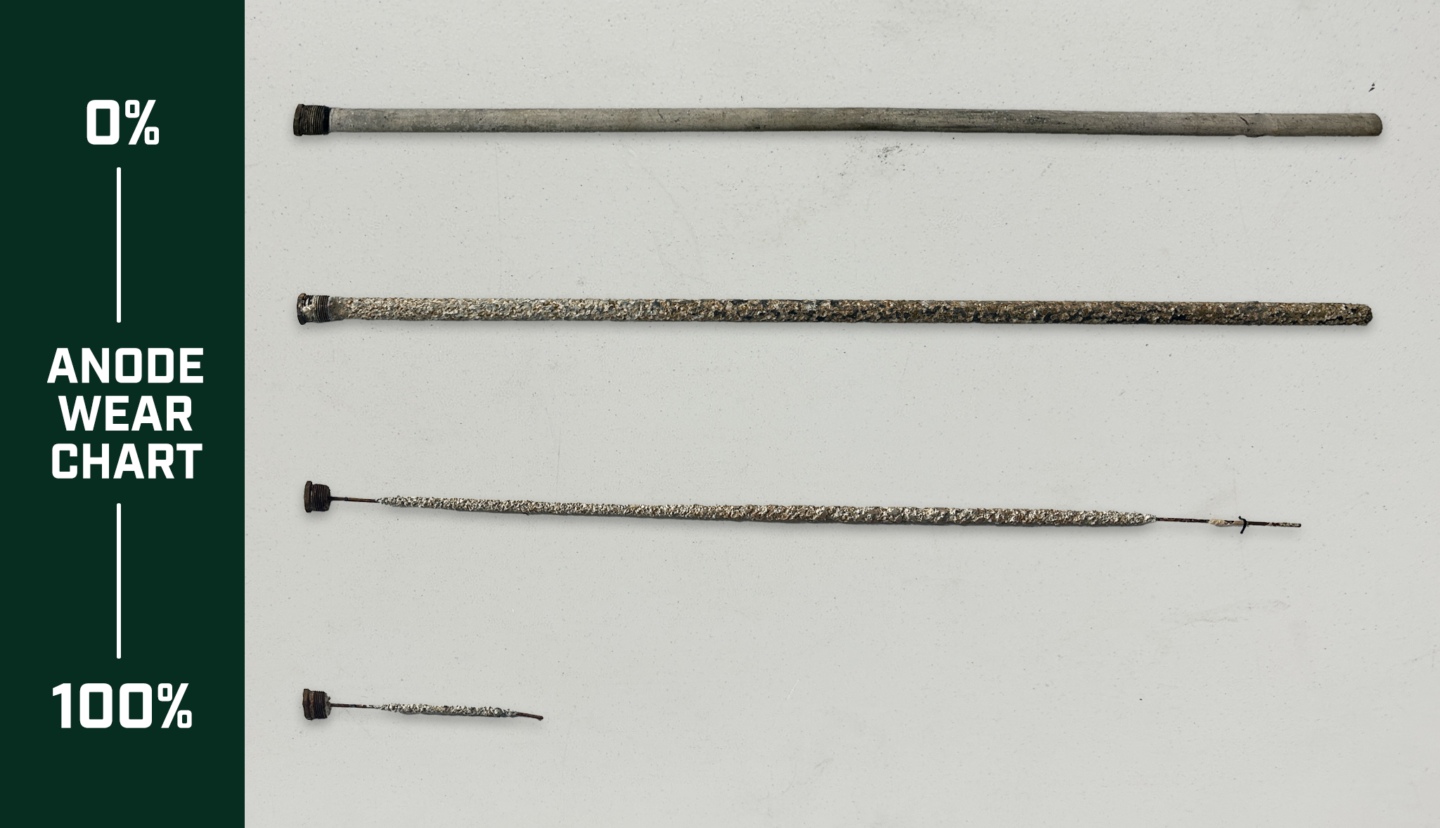
Failure to replace the anode rod can lead to tank corrosion, reduced efficiency, and potential tank failure.
When the anode rod in your water heater no longer works due to wear and tear, it is important to replace your sacrificial anode with a new one. Indeed, this type of magnesium or aluminium anode protects the walls against rust by dissolving its alloy. Another solution is to purchase a Corro-Protec impressed current anode to double the life of your water heater against corrosion and water damage and eliminate unpleasant odours.
Replace a sacrificial anode rod (magnesium or aluminum) when inspection shows it’s significantly worn, typically when about 6 inches (or more) of the steel core wire is exposed, the rod is heavily deteriorated, or it’s so coated in buildup that it can’t protect the tank properly. Most manufacturers recommend inspecting the anode every 1 to 3 years and replacing it when needed (often sooner with hard water or a water softener). Always follow your water heater owner’s manual to keep the warranty valid.
A powered anode rod does not deplete like a sacrificial rod, so it typically does not require replacement.
Anode rods typically last 2 to 5 years, but the real answer depends on your water and how much hot water you use. More “aggressive” water conditions can shorten that timeline, so it’s smart to check the rod regularly.
Two situations that often consume anodes faster are: (1) areas with hard water (more mineral content and typically more deposits in the tank) and (2) homes with a water softener, as many manufacturers note softened water can be more aggressive on the anode, so inspection intervals may need to be shorter.
To protect your warranty, follow your manufacturer’s maintenance schedule. Many brands recommend an anode inspection every 1 to 3 years, and replacement when needed. A. O. Smith, for example, recommends regular tank maintenance and anode rod inspection/replacement when necessary. Best practice: check your water heater owner’s manual for the exact inspection and replacement requirements to keep your warranty valid.
The most common socket size for removing a factory-installed anode rod is 1-1/16″. Corro-Protec uses a 1-3/16″ socket, but the thread size is still the standard 3/4″ NPT since the socket size does not change the NPT size. If your water heater’s anode is in the hot water outlet, you won’t need a socket to remove it.
You cannot clean your anode rod in your water heater .However, it is important to inspect the sacrificial anode rod every 1 to 3 years and replace it after more than 50% of its wear and tear to avoid corrosion of your tank.
Yes, you can cut your sacrificial anode rod, whether it is magnesium or aluminum, to replace it. To do this, use a pair of gloves and a saw and cut as you remove the old anode. However, when you cut the anode, make sure that the bottom part does not fall into the bottom of the tank, as you will not be able to pull it out.
In confined spaces, cutting the anode rod technique is often used. Make sure to dispose the old anode rod in a safe way and as per your environmental waste regulations in your municipality.
If you don’t have enough space and you are tired of changing the anode rod, you should install a powered anode. Only 12 inches long, this anode is made to last over 20 years.
There are several names you can use when talking about an impressed current anode. Impressed current anode rod is simply a synonym for Powered Anode Rod, electronic anode or ICCP system.
For well water, a powered anode rod is the better choice. Sulfur bacteria (SRB) are more common in well systems, and they react with magnesium or aluminum sacrificial anodes to create that rotten egg smell. A Corro-Protec powered anode doesn’t corrode, so it stops that reaction and protects the tank continuously, regardless of your water chemistry. It also requires no maintenance and lasts much longer than a sacrificial rod.
A powered anode rod is often the best choice for well water because it provides long-term corrosion protection and can help eliminate sulfur (“rotten egg”) odor that sometimes shows up in hot water on well systems. Traditional magnesium anode rods can contribute to odor issues in certain conditions, so a powered anode is frequently the better option when smell is a concern.
The answer is no and that is why Corro-Protec offers different models adapted to tank sizes. If your water heater has two anodes, you can replace one of them with our Corro-Protec Powered Anode Rod and leave the other one in place. Even if you install the Corro-Protec Powered Anode Rod to eliminate the rotten egg smell in your hot water, you don’t need to remove the second sacrificial anode.
You can purchase a replacement anode rod at most major retailers online, such as Amazon and Home Depot, authorized reseller and our official website. For long-term protection, choose the Corro-Protec Water Heater Anode Rod.
Corrosion is a chemical reaction when metal reacts with water and oxygen, leading to rust and deterioration. In water heaters, this can cause leaks and damage over time.
The Corro-Protec system prevents corrosion by making sure all materials in your water heater have the same electrical charge, eliminating the risk of galvanic corrosion which occurs from differences in material voltages.
Without Corro-Protec, different metals in your water heater can lead to galvanic corrosion, as the dissimilar metals interact with the electrolytes in water, accelerating corrosion.
Find Your Anode Rod
For almost every tank brand, the anode rod is located at the top of the tank, under a separate plastic cap labeled ‘anode’ and beneath a hexagonal head. Very few tanks have the anode integrated into the hot water outlet, but it’s worth noting that this location is typical for Bradford White.
The anode rod in your AO Smith water heater is located on top of your tank. For most AO Smith water heaters, the anode rod is located in a dedicated anode port and can typically be found under a plastic cap and a foam-insulated layer on the top of the tank. It may be necessary to remove this insulation to gain access to the rod.
Here are some standard locations of the water heater anode rod :
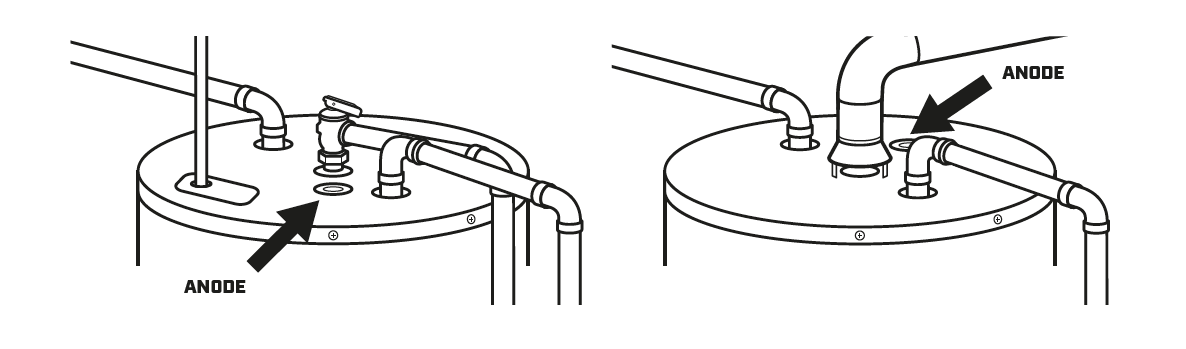
UNCERTAIN ABOUT THE LOCATION OF THE EXISTING ANODE ?
Consult your AO Smith digital or printed water heater owner’s manual for easy guidance.
The anode rod in your electric water heater is typically found at the top of the tank, concealed under a plastic cap and insulation. You will need to remove these components to access the rod. This is the case for almost all electric water heater models. However, it’s important to note that for Bradford White tanks, the anode rod is usually located in the hot water outlet port.
To determine the exact location in your specific model, please refer to your water heater’s user manual. For your convenience, here are links to anode rod locations for several popular brands:
The anode rod in your General Electric (GE) water heater is located on top of your tank. When you are facing the front of your water heater, the sacrificial magnesium or aluminum anode is located at the back of the vent pipe. Refer to your water heater’s user guide for more information.
The anode rod in your Giant water heater is located on top of your tank. More precisely, your magnesium or aluminum sacrificial anode is visible through a hexagonal head located in the center of your tank under a plastic cover. Refer to your water heater’s user guide for more information.
The anode rod in your Kenmore water heater is located on top of your tank. More precisely, your magnesium or aluminum sacrificial anode is visible through a hexagonal head located in the center of your tank under a plastic cover. Refer to your water heater’s user guide for more information.
The anode rod in your Reliance water heater is located on top of your tank. For most Reliance water heaters, the anode rod is located in a dedicated anode port and can typically be found under a plastic cap and a foam-insulated layer on the top of the tank. It may be necessary to remove this insulation to gain access to the rod.
Here are some standard locations of the water heater anode rod :
UNCERTAIN ABOUT THE LOCATION OF THE EXISTING ANODE ?
Consult your Reliance digital or printed water heater owner’s manual for easy guidance.
The anode rod in your Rheem water heater is located on top of your tank. For most Rheem water heaters, the anode rod is located in a dedicated anode port and can typically be found under a plastic cap and a foam-insulated layer on the top of the tank. It may be necessary to remove this insulation to gain access to the rod.
Here are some standard locations of the water heater anode rod :
UNCERTAIN ABOUT THE LOCATION OF THE EXISTING ANODE ?
Consult your Rheem digital or printed water heater owner’s manual for easy guidance.
The anode rod in your Richmond water heater is located on top of your tank. When you are facing the front of your water heater, the sacrificial magnesium or aluminum anode is located at the back of the vent pipe. Refer to your water heater’s user guide for more information.
The anode rod in your Ruud brand water heater is located on top of your tank.When you are facing the front of your water heater, the sacrificial magnesium or aluminum anode is located on your right under a plastic cover.
The anode rod in your State water heater is located on top of your tank. When you are facing the front of your water heater, the sacrificial magnesium or aluminum anode is located at the back, between the cold and hot water connections. Refer to your water heater’s user guide for moreinformation.
The anode rod in your Whirlpool water heater is located on top of your tank. When you are facing the front of your water heater, the sacrificial magnesium or aluminum anode is on your right. Refer to your water heater’s user guide for more information.
Bradford White Water Heater Have Integrated Anode Rod
The anode rod in your Bradford White water heater is located at the hot water outlet of your tank. Unfortunately, it is not easily accessible. You must remove the hot water outlet to access it. Some newer Bradford White models have an anode rod which is not located in the hot water outlet, but in a dedicated port for this anode.
If you’re tired of yearly checks on the anode in your Bradford White water heater or experiencing a sulfur smell in your hot water, we have a reliable solution for you. By installing the Corro-Protec powered anode, you can eliminate the need for frequent inspections and enjoy maintenance-free water heater protection.
The Corro-Protec powered anode rod effectively stops corrosion, eliminates the sulfur smell, requires no maintenance, and comes with a 20-year guarantee for your peace of mind. With this innovative solution, you can ensure long-lasting performance without the hassle of annual anode checks.
Having Trouble Finding It?
Contact-us with your Bradford White water heater model number and we would be happy to help you locate it.
You can also contact the manufacturer directly. With Bradford White’s customer support, you can rely on their expertise to help you locate the anode rod in your specific model, such as the Bradford White RG250T6N. Their dedicated team is ready to assist you in finding the exact placement of the anode rod, ensuring you have all the information you need to keep your water heater in optimal condition.
Water Heater Leaks
Water heater will remain in function even if there’s a small leak as long as the water don’t reach any electronics or satefy. However you should change the water heater immediately is it’s leaking.
Yes, turning the cold water off will stop the leak and reduces chances of water damage. Make sure to turn off power supply to the water heater and drain the tank before replacing it.
Water heater gas leak can be very dangerous. Make sure to turn off gas supply and call a specialist right away.
The main reason for a water heater leak is corrosion. Aggressive water will attack the weakest points inside the tank and will create a leak.
Make sure to change your water heater anode rod every year or install a Corro-Protec anode in order to stop corrosion inside your tank and prevent water heater leaking.
The quickest fix is to get it changed. Honestly, a leaky water heater will be hard to repair and will leak from a different place soon since this normally indicated the end of its service life.
If you want to investigate why your water heater is leaking, visit our blog post :
A water heater leaking from the overflow pipe means the temperature and pressure relief valve need to be changed. See our step-by-step guide on how to change the T&P valve on your water heater.
If you notice your water heater leaking from the overflow pipe, it’s usually a clear sign that your temperature and pressure relief valve (T&P valve) needs to be replaced. The T&P valve is an essential safety device that discharges water when the temperature or pressure becomes too high for the tank to handle.
Not to worry, we’ve compiled a straightforward, step-by-step guide to help you changing the T&P valve on your water heater. It’s an important skill to have, as ensuring the proper function of this valve is crucial to the safety and longevity of your water heater.
If you’re in need of a new T&P valve, we’ve got you covered. We’ve conducted thorough research and found the highest quality pressure relief valves available on the market. Check out our top pick for a reliable and effective solution to your overflow leak problem.
With the right tools, parts, and guidance, you’ll have this issue resolved in no time, ensuring your water heater is operating safely and efficiently.
Depending on the leak, we suggest replacing the hot water tank immediately. A water heater leaking can create many expensives problems on the long run and this is a sign you need to change it.
However, there’s way you can easily double the life of your next water heater. Protect your investment by installing a Corro-Protec anode rod.
Water Heater Noise
Popping sounds are usually caused by sediment buildup at the bottom of the tank. When water heats, steam bubbles form under the sediment and burst. Flushing the tank will often resolve this issue.
Not all noises are dangerous, but persistent noises may indicate underlying problems, such as sediment buildup or a malfunctioning component. If noises persist after maintenance, it is best to consult a technician
If noises persist after flushing the tank, consult a professional technician. A more complex issue may require attention.
Pressure Relief Valve & Overflow
The valve is typically near the top or side of the water heater tank, connected to a discharge pipe.
Common causes include excessive pressure, sediment buildup, or a worn-out valve.
Place a bucket under the discharge pipe, lift the handle to release water, and ensure the valve closes properly when you release the handle.
It can be hot since it’s connected to the tank and releases hot water during normal operation.
To ensure correct function, the valve should be tested at least once a year.
Minor issues like debris can sometimes be resolved by cleaning the valve. However, replacement or professional assistance is required if the valve is damaged
If the valve consistently leaks despite normal pressure and temperature levels or shows signs of damage, replacement is necessary.
People often look for water hater overflow pipe but the real term is Water Heater Pressure and Temperature relief valve. We have a complete blog post about it : Water Heater Pressure Relief Valve
Yes, occasional dripping is normal when your water heater releases excess pressure or heat. However, constant dripping or heavy leakage often indicates a problem that needs attention.
Continuous dripping from the overflow pipe, visible corrosion, or mineral buildup around the valve are signs of a faulty T&P valve. If you notice these issues, consider replacing the valve.
Regular inspections are recommended at least once a year. This helps identify potential problems early, ensuring the safety and efficiency of your water heater.
Some issues, like adjusting the thermostat or checking water pressure, can be addressed by homeowners. However, more complex repairs, such as replacing the T&P valve or installing an expansion tank, should be handled by a licensed plumber.
Yes, the overflow pipe is connected to the T&P valve and only activates when the valve releases water due to high temperature or pressure. Its purpose is to safely direct water away from your home.
If left unresolved, a leaking overflow pipe can lead to water damage around the tank or contribute to more significant issues, such as rust and reduced efficiency. Address leaks promptly to avoid costly repairs.
Gas & Electric Water Heaters
Both gas and electric water heaters are available. The best choice depends on energy availability, operating costs, and installation requirements in your home.
Gas water heaters have a gas line and a burner compartment near the bottom. Electric water heaters have no gas line and typically have access panels on the side for heating elements. Visit our guide for more details on how to check if your water heater is gas or electric.
Electric water heaters are often easier to install and maintain, while gas models typically heat water faster and may cost less to run in some areas. The “better” option depends on local energy prices and your home’s setup.
A gas water heater uses a burner to heat water in the tank. The thermostat controls the burner to maintain the desired water temperature.
Most traditional gas tank water heaters can heat water without electricity, but some models need power for electronic ignition, controls, or a blower fan. If your unit has a plug or electronic display, it likely needs electricity.
- 1. Turn the gas control to OFF and wait a few minutes.
- 2. Find the lighting instructions (usually printed on a sticker on the water heater).
- 3. Turn the gas control to PILOT.
- 4. Ignite the pilot as instructed (built-in igniter/button or an approved long lighter, depending on the unit).
- 5. Hold the control as directed, usually 30-60 seconds, then release.
- 6. Turn the gas control to ON (and set the temperature back to your usual setting).
*If you smell gas at any point, stop and contact a professional.
Follow the manufacturer’s instructions, which usually involve turning off the gas and wait, lighting the pilot, and setting the gas valve to ‘On.
Turn off the gas and water supply, attach a hose to the drain valve, and open the valve to drain the tank.
For most units, set the gas control valve to OFF. If there’s a manual shutoff valve on the gas line, turn it to the OFF position (for lever-style valves, the handle is OFF when it’s perpendicular to the pipe).
Heat Pump Water Heaters
A heat pump water heater uses electricity to move heat from the surrounding air into the water tank, making it much more energy-efficient than standard electric water heaters.
It works like a refrigerator in reverse: instead of removing heat, it pulls heat from the surrounding air and moves it into the water tank. When there’s a high demand for hot water, it can switch to standard electric heating to keep up.
Often yes because a heat pump water heater can use up to ~70% less energy than a standard electric tank, so the savings add up quickly. Water heating is also a big chunk of the bill: it’s about 18% of a typical home’s energy use/utility bill in North America.
Typical costs vary by size and installation complexity. In the U.S., the unit usually runs about US $1,500-US $3,000, and installation is typically US $500-US $2,000 depending on any plumbing/electrical upgrades needed.
In Canada, the unit is often around CA$2,000-CA$4,000 depending on size and brand, and installation commonly adds CA$1,000-CA$3,000+, depending on the job complexity and local rates.
Common drawbacks include higher upfront cost, the need for adequate space/airflow, some operating noise, and reduced efficiency in colder locations or cold basements/garages.
Heat pump water heaters are noisier than electric or gas models, with noise levels similar to refrigerators. Proper installation and maintenance can minimize operational noise.
Tankless Water Heaters
Installing a tankless water heater involves connecting it to your plumbing and electrical (or gas) systems. Due to its complexity, it’s recommended that you hire a professional installer, especially for gas models that require venting.
The cost of a tankless water heater varies depending on the brand and type. On average, electric models range from US $500 to US $1,500, while gas models can cost between US $1,000 and US $3,000 for the unit alone. In many cases, installation is the most significant cost, since it’s usually done by a licensed professional and may require venting, piping, electrical, or gas-line modifications, especially for gas models.
Routine maintenance is critical to extend the life of your water heater. This includes descaling the unit every year or two to prevent mineral buildup, checking the gas lines, and cleaning the air intake and exhaust vents.
While some portable propane tankless water heaters are easy to install, most home and RV units require professional installation due to proper ventilation and gas line connections. Always consult a professional to ensure safety and efficiency.
The amount of propane a tankless water heater uses depends on the flow rate and how often you use hot water. On average, a propane tankless water heater can use about 1-2 gallons of propane per hour when actively heating at maximum output. Smaller units, such as RV propane tankless water heaters, typically use less propane, making them a more efficient option for portable needs.
RV Water Heaters
The smell is usually caused by hydrogen sulfide gas, often produced by bacteria or organic material in your RV’s water system. If the odor is mainly in the hot water, it can also be linked to a reaction inside the water heater, especially with a magnesium anode rod.
Flush and sanitize your water lines (using hydrogen peroxide or a manufacturer-approved sanitizing method such as diluted bleach), and maintain your water heater and anode rod regularly to prevent sulfur smells.
It is important to change the sacrificial anode in your RV every year for a steel water heater. Aluminum tanks are generally not equipped with replaceable anodes because they have an inner coating of zinc and aluminum with the same protective function.
Our innovative RV models of powered anode rods have been specifically designed to be compatible with Suburban, Mor-Flo, and Atwood water heaters. Each brand can be seamlessly integrated with either a standard 120V outlet or your RV’s 12V battery system, enhancing flexibility and ease of use.
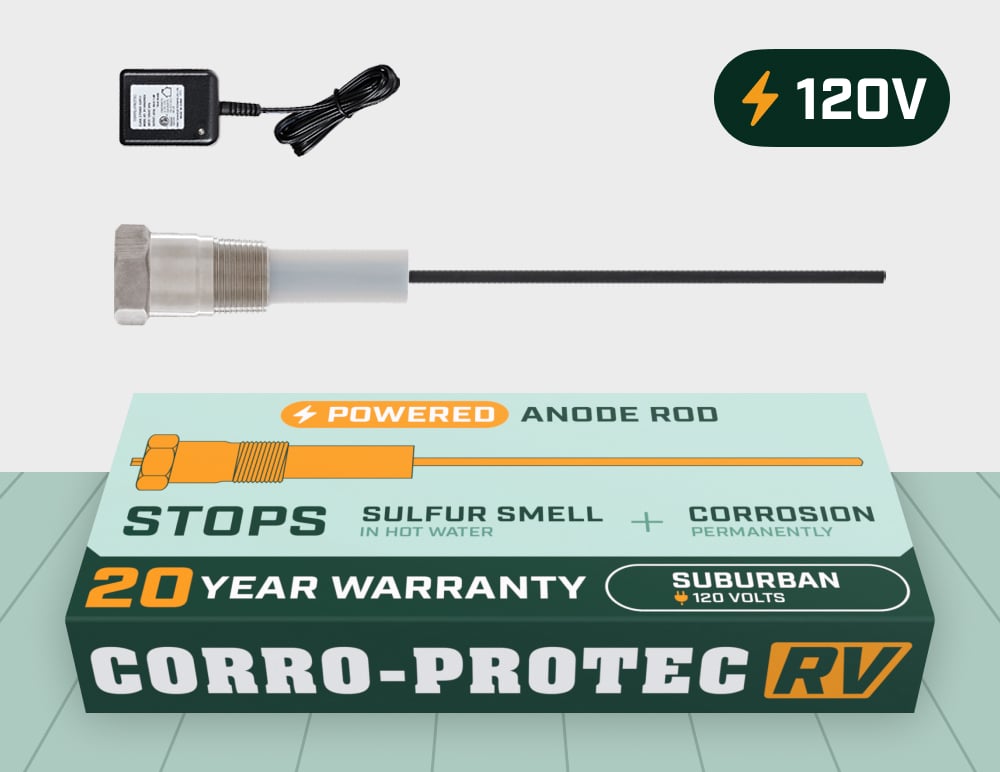
First, turn off the water heater and disconnect the power to replace the anode rod. Then, locate the anode rod at the top of the tank, unscrew it, and inspect it for corrosion. If necessary, replace it with a new one.
The best Suburban water heater depends on your specific needs, such as the size of your RV, the number of occupants, and your hot water usage. A 6-gallon model may suffice for smaller RVs, while larger RVs or those needing more hot water may benefit from a 10- or 12-gallon model or even a tankless option.
Water Heater Brands
Yes, AO Smith water heaters are known for their reliability, efficiency, and long lifespan, making them a popular choice among consumers.
You can determine the age of your AO Smith water heater by decoding the serial number found on the unit. Refer to the AO Smith water heater manual for instructions on reading the date code.
To drain your AO Smith water heater, turn off the power and water supply, attach a hose to the drain valve, and open the valve to let the water flow out.
To reset your AO Smith water heater, locate the reset button on the thermostat and press it. If the heater does not reset, consult the user manual or contact AO Smith customer service for further assistance.
Your A.O. Smith water heater can use magnesium, aluminum, or powered anode rods, but the powered anode rod is the best option. Powered anodes are suitable for all water types: hard, soft, well, or city water making them the most versatile solution. They never need to be replaced, eliminate rotten egg smell, and prevent your tank from corrosion. By comparison, magnesium and aluminum rods provide only temporary protection. Magnesium anode rods are not effective in hard water, while aluminum anode rods are not effective in soft water. Both are sacrificial, require regular maintenance, and eventually must be replaced. Compare aluminum and magnesium anode rods here. For homeowners who want long-term, maintenance-free protection, powered anode rods are the clear superior option.
- Turn the gas control knob to “Pilot.”
- Press and hold the reset button while lighting the pilot.
- Hold for 60 seconds, then release.
Rheem water heaters typically last 8-12 years with proper maintenance.
Check the serial number on the unit. The first four digits typically indicate the month and year of manufacture.
- Turn off the power and water supply.
- Attach a hose counterclockwise to the drain valve.
- Open the valve and let the water drain.
Bypassing the control board is a technical process that should only be done by a professional. However, it involves disconnecting the board and wiring the heater to function without its advanced controls.
Parts can be found at home improvement stores, online retailers, or authorized Whirlpool dealers. Our website offers powered anode rod that fits Whirlpool tanks.
Check the serial number on your water heater. The first few digits often represent the month and year of manufacture.
First, turn off the heater’s power. Then, remove the access panel, disconnect the faulty switch, and follow the manufacturer’s instructions to replace it with a new one.
The anode rod helps prevent corrosion inside the water heater tank. It attracts corrosive elements in the water, which would otherwise rust the tank walls.
Yes, powered rods also work in hybrid tanks.
If the sacrificial anode rod is left to deteriorate completely, the tank itself can start corroding. This can lead to rust, leaks and eventually tank failure, which is far more expensive to replace.
GIANT’s warranty states that all anodes must be checked at least once every 2 years and replaced if needed to meet the maintenance requirements. Always follow the inspection and replacement schedule in your owner’s manual to keep your warranty valid. If you have a powered anode rod (titanium), it does not deplete like a sacrificial anode, so it typically doesn’t require replacement.
Most storage-tank Kenmore heaters do. Tankless models do not.
Yes, replacing an anode rod is a DIY-friendly project. With the right tools (like a socket wrench or breaker bar), you can safely remove the old rod and install a Corro-Protec. Just be sure to shut off the power and water supply first.
Powered anode rod do not need replacement. Standard sacrificial anode rods typically need to be replaced every 1-3 years, depending on your water quality. If you have hard water, well water, or use a water softener, the rod may deplete faster.
Need Assistance?
Our technical support team is ready to answer all your questions and help you solve any problems you are experiencing.